Ancient Global Empire Before the Catastrophe: A World Without Borders
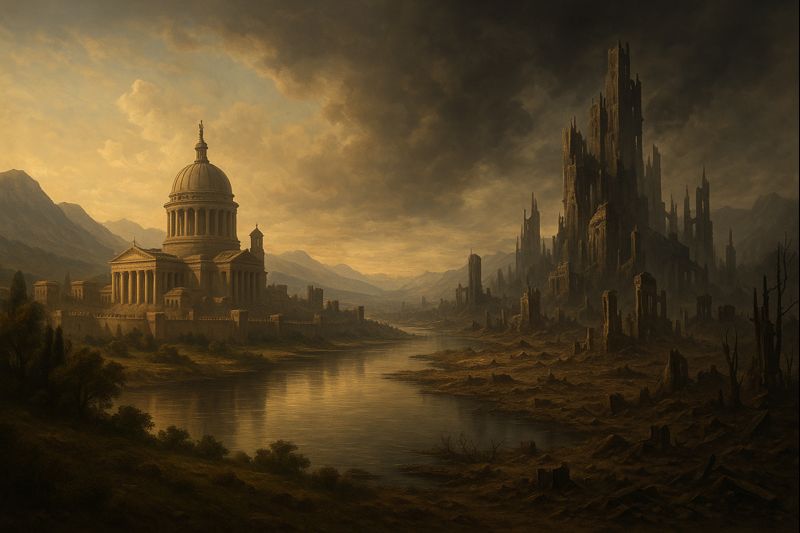
Hello! Have you heard of Great Tartary? There’s a theory called the Ancient Global Empire, which proposes that long before the dawn of recorded history, humanity lived under the rule of a single global civilization. According to this idea, there were no borders, nations, competing languages, or religions. The Ancient Global Empire was united—culturally, technologically, and socially—until a global catastrophe or war destroyed the world forever.
This theory challenges the modern historical narrative and raises a provocative question: what if division isn’t humanity’s natural state, but rather an artificial one? You’re familiar with the expression “divide and conquer,” right? Let’s continue.
The Ancient Global Empire and a Unified Human Civilization
Proponents of the Ancient Global Empire theory argue that humanity once functioned as a single, interconnected civilization. People moved freely across continents. Knowledge was passed down from generation to generation, not kept secret. Architecture followed similar principles across the globe, and symbols were repeated in different regions, indicating a common origin rather than chance.
Rather than disparate cultures developing independently, the world may have functioned as a single system—with shared technologies, a common worldview, and perhaps even a universal language or mutually understood forms of communication.
Traces of this unity may still exist in ancient structures, myths of a lost golden age, and unexplained technological remnants that appear to far predate officially established timelines. This overlaps with the “erased timelines” motif — where the physical world hints at a younger official chronology than it should.
A Global Catastrophe That Ended the Ancient Global Empire
The fall of the Ancient Global Empire was not gradual. It was apparently sudden and devastating. A global catastrophe — whether a major war, an ecological collapse, an energy crisis, or a combination of events — destroyed the core of this civilization. Infrastructure collapsed. Knowledge centers were lost. Communication between regions was severed. The survivors were scattered and isolated, forced to rebuild piecemeal rather than as a unified whole.
This moment marked the true beginning of what we now call “civilizations” — not as progress, but as recovery from collapse. If parts of the past seem missing rather than unknown, the concept of the “Lost Century” helps explain how continuity can be maintained while mitigating the effects of upheaval.
Division as a Tool of Control
After the catastrophe, humanity didn’t simply recover—it reorganized. According to the theory, the world was deliberately divided according to the principle of “divide and conquer.” A unified population is difficult to control. A divided one is not.
This division took many forms:
– Borders separated lands that were once connected;
– Languages became fixed and isolated from one another;
– National identities formed;
– Religions became formalized and pitted against one another.
The fragmentation of humanity shifted attention from the lost unified past to conflicts between newly formed groups. Instead of asking what happened to the world, people began to ask who belonged where and who didn’t.
Rewriting History After the Fall
The official historical record may have been written after the collapse of the Ancient Global Empire. In this version of history, ancient societies are portrayed as isolated, primitive, and technologically limited. Similarities between distant cultures are dismissed as coincidences. Advanced structures are explained away or misdated. Myths of destruction and rebirth are reduced to symbolic stories rather than memories of actual events.
Nevertheless, certain patterns persist:
– recurring architectural forms across continents
– shared myths of floods, fires, and devastation falling from the sky
– legends of teachers or “gods” arriving after the great collapse
– technological anomalies that don’t fit into accepted chronologies
These inconsistencies suggest that history may be incomplete—or deliberately simplified. Perhaps our memories have been erased, reprogrammed. We have been forced to abandon the past and forget it. We’ve been given a falsified version of history, tailored to the ruling class. What do you think about this?
Why the Ancient Global Empire Matters Today
If Great Tartary truly existed, it changes our understanding of the modern world. Borders, national rivalries, and ideological differences are no longer the inevitable consequences of human nature, but the product of a system that emerged after a catastrophe.
Perhaps humanity is not learning to unite for the first time, but is remembering what it once lost. The question is no longer whether unity is possible, but whether we are allowed to remember that it once existed. What are your thoughts on this matter? Share your thoughts in the comments.

Post Comment