
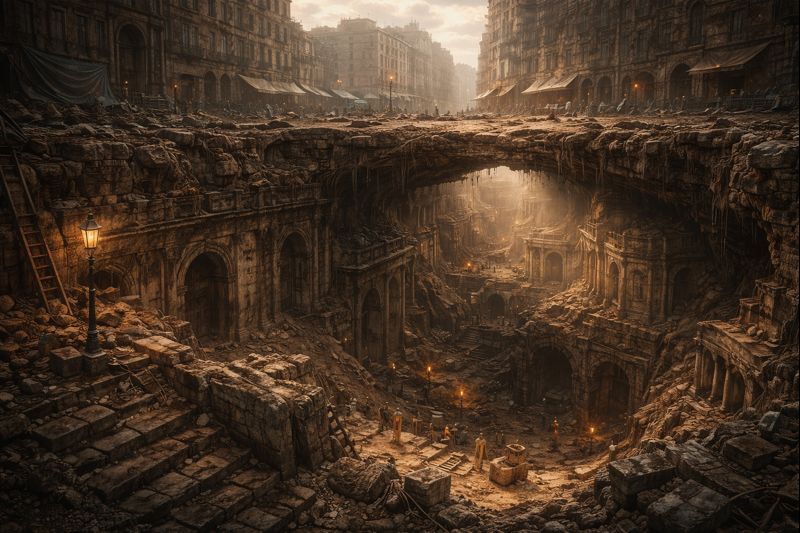
Hi! Have you ever noticed that there are “buried cities” all over the world where, for some mysterious reason, the lower floors of buildings have ended up completely buried underground? Entire streets lie several meters below the current ground level. Windows are half-buried, and doorways lead straight into the ground. Stairs descend to what was once the surface. Such anomalies can be found from Europe to Asia and the Americas. And here’s the most intriguing question: why does this pattern repeat itself all over the world?
According to the official version put forward by historians, this is due to the construction methods of the time or the accumulation of cultural layers. But these explanations seem absurd when one considers the consistency, symmetry, and almost deliberate nature of the burial of these architectural structures. What actually happened? There are several theories on this subject.
One of them suggests a global cataclysm—not necessarily a single catastrophe, but a series of rapid events that buried ancient cities under layers of earth and debris. Another theory suggests that many previously existing civilizations were destroyed and replaced so quickly that it was easier to rewrite their history than to explain what actually happened.
The Evidence Hidden Beneath History
The deeper you delve into this topic, the more contradictions you will uncover. Historical maps that do not align with the official version of history, architectural masterpieces that were ahead of their supposed era, and old photographs depicting technologies and construction methods that do not fit the chronology. Think of the burned libraries and “lost” archives around the world. Entire cultures that have been reduced to myths because their existence did not fit into the official chronology. So I’ll ask a simple but radical question: what if our chronology is not only incomplete but has also been edited?
In the article “The Lost Century,” I propose a structural explanation for this possibility, hypothesizing that the gaps in the chronology were not accidental but were “absorbed” in order to preserve continuity following major upheavals.
Some researchers believe that humanity may have experienced several cycles of “reset” of civilization. After each such reset, the survivors or new arrivals inherited the ruins and the few things that had survived. And those who controlled the subsequent written history shaped the chronology in accordance with their worldview and power structure. After all, history is not simply what happened, but what passed censorship and was approved for the masses.
Buried Cities and Erased Timelines
If buried cities truly represent the remnants of a former world, then our modern civilization may literally stand on someone else’s forgotten history. And if parts of that history were lost, altered, or misunderstood, they may reveal more about our present than we realize. Are we the first peak of human development? Or merely the latest layer in a repeating cycle?
Alternative history doesn’t claim to have definitive answers. Instead, it encourages us to question assumptions, examine overlooked evidence, and consider whether the conventional timeline tells the complete story. Perhaps the most important discoveries are not the ones that confirm what we already believe, but the ones that force us to reconsider what we thought we knew.
FAQ
Q: What are the most famous examples of buried cities?
A: Parts of Edinburgh, Seattle, Paris, Naples, Istanbul, and dozens of Eastern European cities have buildings and streets that appear to have lower levels beneath today’s ground level.
Q: Could natural processes cause all these anomalies?
A: Natural processes can explain some cases, including sediment accumulation, rebuilding, and changes in street levels. Whether they can account for every example remains a subject of debate.
Q: Is there proof history was rewritten?
A: There is no single piece of conclusive evidence proving that history was deliberately rewritten. However, inconsistencies in maps, documents, architecture, and oral traditions continue to raise questions about how completely the past has been recorded.