The Lost Century: A Missing Era in Human History
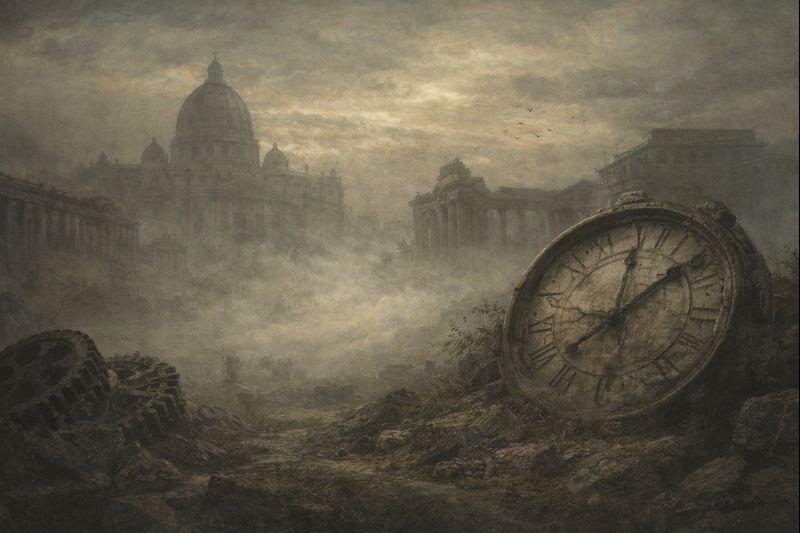
Welcome, wanderer! Today I’ll discuss the concept of the “Lost Century”—a hypothesis born not from fantasy but from a careful study of historical chronologies. Upon closer examination of the past, certain periods appear unnaturally muted—not chaotic, not transitional, but carefully smoothed over, as if continuity were more important than precision.
In this context, the “Lost Century” refers to a missing or obscured era in human history, a period of time that may have been erased, compressed, or subtly adjusted to maintain a stable narrative. Rather than proposing a dramatic conspiracy, this article explores structural patterns: how such gaps form, why they persist, and what subtle traces they leave. Intrigued? Then let’s get started!
The Lost Century and the Problem of Historical Continuity
Historical reconstruction is based on a continuous process. It is assumed that dates follow one another sequentially, technologies develop gradually, and cultures leave behind material, textual, or architectural traces. However, across civilizations, this continuity is repeatedly disrupted.
We encounter long periods reduced to vague descriptions, dynasties that existed only nominally but lacked material evidence, dramatic leaps in engineering or social organization, and cultural restructurings without a clearly defined cause. Individually, these anomalies are explainable. However, taken together, they point to a systemic distortion, not a random loss.
One way to interpret these gaps is to consider longer, pre-recorded phases of civilization — including the idea of an ancient global empire before the catastrophe. Let’s continue.
Time as Something That Can Be Corrected
It’s no secret that modern historiography views time as a linear and irreversible phenomenon. However, many earlier societies understood it differently. Cyclical eras, repeated renewals, and post-catastrophic resets are found in mythological and philosophical traditions around the world. Coincidence? I don’t think so!
Within such concepts, preserving social integrity after upheavals would be more important than maintaining an accurate chronology. Data adjustments, the compression of events, or the exclusion of destabilizing periods would be perceived not as falsifications, but as necessary adjustments. I hope this is clear.
Architectural Evidence and the Silence of the Record
Architecture often preserves what written history fails to capture. Monumental stone structures, precisely engineered foundations, and urban layouts reused by later, less technologically advanced societies are found all over the world. Haven’t you noticed?
The mystery lies not only in how these structures were created, but also in why the knowledge necessary to reproduce them disappeared so completely. Even a relatively short period of time could interrupt the chains of knowledge transmission, creating the illusion of regression where continuity once existed.
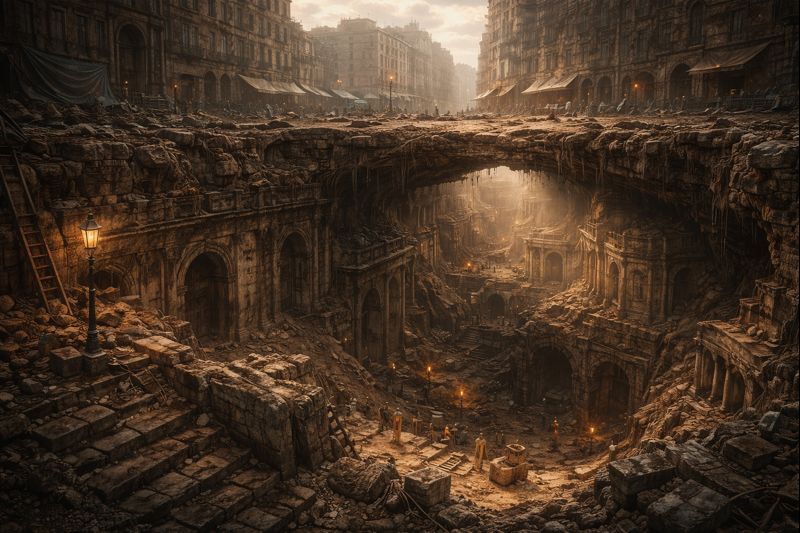
This kind of rupture becomes easier to imagine when you look at buried street levels and “first floors” that sit underground — a pattern explored in my piece on buried cities and erased timelines. This is a very interesting topic. I recommend checking it out — you won’t regret it!
Compressed Chronology and Narrative Smoothing
One of the most effective ways to conceal a gap is not erasure, but compression. Chronological compression combines generations, extends or shortens reigns, and brings unrelated events into a single explanatory thread.
This process allows history to remain readable and internally consistent while absorbing discontinuities. In this sense, the “Lost Century” isn’t absent; it’s woven into the adjacent time, rendered invisible by the effectiveness of narrative. I hope this is clear. Let’s continue.
Why a Lost Century Would Be Obscured
If an era is deliberately glossed over or omitted, the motives need not be malicious. Societies recovering from collapse typically prioritize legitimacy, stability, and psychological continuity over exhaustive accuracy.
Disasters, institutional failures, the loss of accounting systems, or dramatic shifts in the balance of power can lead to historical simplifications that foster cohesion. Over time, these simplifications become accepted, albeit distorted, truths. Therefore, it is important not to accept everything history textbooks teach at face value.
Maps, Calendars, and the Subtle Rewriting of Time
Maps and calendars don’t simply reflect reality; they structure it. Old maps sometimes depict cities, borders, or coastlines that contradict official chronologies, and calendar reforms repeatedly reset years without altering the physical world.
An era doesn’t necessarily have to be destroyed for its monuments to disappear. It can vanish through renumbering, reinterpretation, and selective emphasis. This, in fact, has repeatedly happened throughout human history. And this is an undeniable fact.
For a closer look at how visual narratives can reshape chronology, see my review of fake historical maps — where “evidence” often arrives already framed. This is also a very important topic that needs to be addressed to get the full picture.
Absence as a Structural Feature of History
Do you know what’s most disturbing about a lost era? How easily absence becomes the norm. When records aren’t rewritten, when stories are no longer told, silence becomes organically woven into the historical context. And that’s true.
Ultimately, questions cease to arise not because answers exist, but because the gaps are smoothed over beyond recognition. Do you agree with this statement? Or perhaps you have a counterargument?
Why the Lost Century Still Matters
Contemporary society often considers itself immune to large-scale forgetting, yet even now narratives are edited, archives are destroyed, and context is lost. Awareness of the possibility of a “lost century” reminds us that history isn’t simply discovered; it’s constantly maintained. What persists shapes identity. What disappears defines its boundaries.
Conclusion
A “lost century” may not correspond to a precise block of missing years. Rather, it may describe a structural “blind spot” created when continuity was maintained at the expense of completeness.
History rarely announces its changes. More often, it disappears where memory should resound. After all, as the saying goes: history is told by the victors. Therefore, accepting it as absolute truth without analysis and skepticism is certainly inadvisable.







Post Comment