
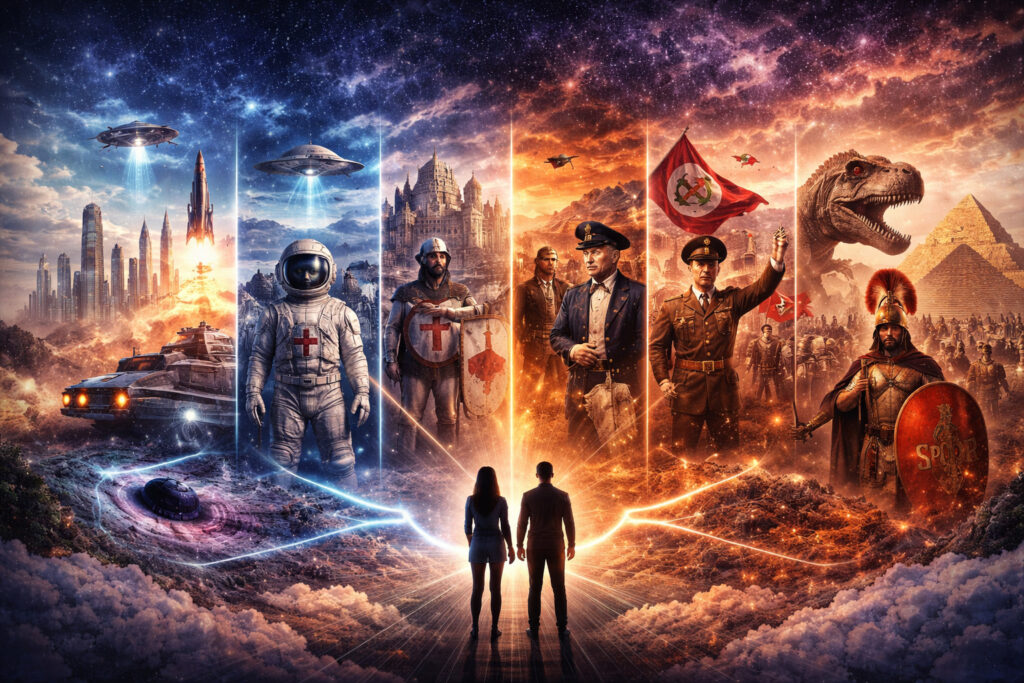
Hello! Have you ever wondered how reliable the history we know, the one we’re taught to believe, really is? If you’re interested in alternative history, I’m sure you’re already questioning the version you’ve been taught. After all, you’ll agree that the official version is full of inconsistencies, gaps, and omissions. For those who hold a different opinion, I have a question: what is history, and how do you understand it?
We usually think of history as a collection of established facts—dates, events, rulers, wars and peace treaties, civilizations and discoveries, carefully recorded in chronicles or historical documents and passed down from generation to generation. But if you think about it, history isn’t the past itself, but our reconstruction of the past, based on surviving sources. And that’s where things get interesting.
The fact is that historical records can be incomplete, contradictory, politically motivated, or written from the perspective of those in power. It’s not for nothing that they say that history is written by the victors. Entire documents and traditions have been lost, others destroyed, rewritten, translated, or reinterpreted. In some cases, different sources describe the same event completely differently.
This doesn’t necessarily mean that everything we know about history is false. But, in my opinion, it does suggest that some parts of the traditional historical narrative deserve more careful examination.
Alternative History: An Independent View
As an independent researcher, I’m particularly interested in gaps and inconsistencies that often go unnoticed: unexplained archaeological finds, disputed chronologies, strange similarities between distant cultures, technologies that seem astonishingly advanced for their time, and historical events for which traditional explanations leave questions unanswered.
For me, alternative history isn’t about replacing one irrefutable story with another. It’s about being willing to ask uncomfortable questions and trying to get to the truth. After all, who decides which version of events will be accepted? Which sources survive, and which have been lost? To what extent have politics, religion, conquest, and cultural change influenced how the past was recorded? Perhaps some historical mysteries have accepted explanations. Perhaps others will require us to rethink what we thought were reliable historical facts.
I don’t claim to have definitive answers. My goal is simply to examine the available evidence, compare different interpretations, and explore the possibility that the story of our past may be more complex than the version we’ve been taught. By studying and comparing different versions, perhaps we’ll arrive at the truth.
FAQ
Q: Does alternative history mean the official version is completely false?
A: No. Alternative history doesn’t require us to abandon everything we know about the past. It involves testing specific interpretations, exploring inconsistencies, and considering whether some generally accepted conclusions merit further investigation.
Q: Why might historical accounts contradict each other?
A: There can be many reasons: incomplete records, lost or destroyed sources, political and cultural bias, differences in interpretation, translation errors, or later revisions of historical events. Q: Are alternative historical theories scientifically proven? A: Not necessarily. Some claims are supported by reliable historical or archaeological data, while others remain mere conjecture. It is important to distinguish between documented evidence, reasonable interpretation, and pure speculation.
Q: Why should we question the accepted version of history?
A: Because doubt is not the same as denial. History is rebuilt based on evidence, and when new evidence emerges or old assumptions are challenged, our understanding of the past can change.