Is the Universe a Simulation? Science vs. the Matrix Hypothesis
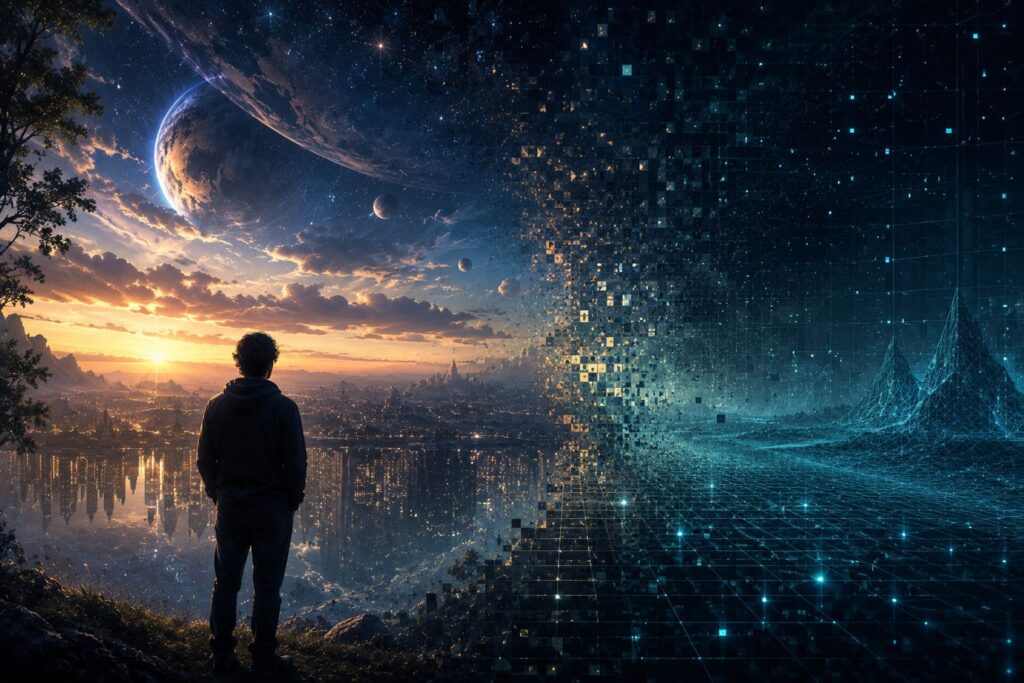
Are we living in the Matrix (a simulation)? This question has puzzled many. Here’s what we know. There is currently no scientific evidence that we live in a computer simulation similar to The Matrix. While this idea has gained popularity thanks to science fiction, philosophy, and advances in artificial intelligence, it remains more of a speculative and irrefutable hypothesis than a well-established scientific theory.
The Simulation Hypothesis
Let’s first go back to the source. As we know, the simulation hypothesis was popularized by philosopher Nick Bostrom in 2003. It proposes that a technologically advanced civilization will eventually be able to develop sufficient computing power to simulate conscious beings or even entire universes.
The central argument is statistical in nature: if there are countless simulated realities, while only one “base reality” exists, then it’s more likely that we live inside one of these simulations. However, this is more of a philosophical argument than empirical proof.
Scientific Problems
It’s worth noting that in the scientific world, the hypothesis that we live in a simulation has many supporters, but also just as many opponents. In fact, many prominent physicists doubt the feasibility of such a simulation. I’ll explain why now.
The bottom line is that ultimately, accurately simulating every quantum interaction in the entire observable universe would require an incredible amount of computing power—potentially exceeding all the information and physical resources available in our own (real) universe. While this isn’t a 100% irrefutable mathematical proof of the hypothesis that we live in a simulation, it nonetheless highlights the enormous practical difficulties associated with it. Perhaps humanity, at its current stage of development, is simply incapable of delving deeper into this area of knowledge?
Some researchers also argue that digital simulations are likely to reveal signs of discretization or computational limitations. However, observations of nature have so far provided no convincing evidence of such limitations. Or have they? What are your thoughts on this?
Philosophical Origins
Let’s consider this hypothesis from a philosophical perspective. This idea existed centuries before the advent of modern computers and artificial intelligence.
The creators of The Matrix were initially inspired by the “father of modern philosophy,” René Descartes, who proposed the “evil demon” thought experiment, questioning the possibility of systematically deceiving our senses. Similar themes are also found in Eastern philosophy; For example, the Mayans viewed the material world as an illusion or projection, not as a higher reality. Personally, I wonder where these ancient civilizations got such knowledge and concepts? Perhaps they knew something we don’t yet know?
These philosophical musings merely explore the limits of human perception but offer no scientific proof. Or perhaps modern science isn’t yet ready to provide such proof? What do you think?
Are we really living in the Matrix (a simulation)?
In short, one thing is clear: based on the available data, or what we can simply understand, one can conclude that the simulation hypothesis in the scientific world is currently only an intriguing philosophical possibility and a fascinating topic for heated scientific debates or simple conversations around an evening campfire. However, convincing empirical evidence that our universe is an artificial computer simulation is still lacking. But perhaps it will appear soon?
Until testable predictions or observational data are found, this idea should be viewed more as an interesting thought experiment than a sound scientific explanation of reality. That’s all I wanted to say. What do you think?





Post Comment