
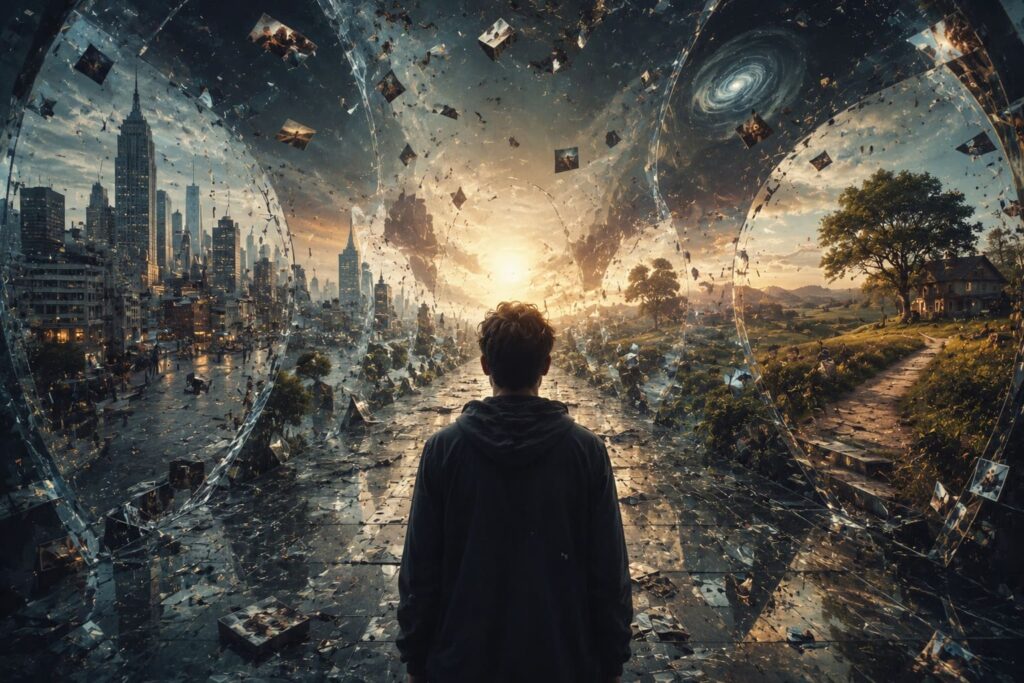
The Mandela Effect is a recently popularized phenomenon in which large groups of people share identical, inaccurate memories of historical events or pop culture. It is often cited as controversial evidence for the existence of a multiverse. Furthermore, some theorists argue that these collective memory distortions are actually true memories of alternate realities that have “spilled over” into our current timeline. What’s your idea?
The Multiverse and Quantum Explanations
The idea that parallel realities cause these memory discrepancies is typically rooted in speculative interpretations of theoretical physics:
- Many-Worlds Interpretation: Proposed by physicist Hugh Everett, this quantum theory suggests that all possible alternate histories and futures are real, each existing in its own continuously branching universe. Some suggest that our consciousness may occasionally shift between these parallel branches.
- “Reality Shift”: Proponents of this concept propose that when people collectively recall a different version of past events (such as spelling the name “Berenstein Bears” as “Bernstein” or the existence of a cornucopia from Fruit of the Loom), they are actually connecting to memories from a neighboring universe.
- “Dimensional Rip”: A popular, albeit pseudoscientific, offshoot theory links reality shifts to high-energy particle physics experiments, such as those conducted at CERN, suggesting that large-scale operations can cause rips in time and space.
Psychological and Neurological Consensus
While the parallel universe theory is popular in the science fiction and paranormal communities, scientific and psychological consensus attributes the Mandela Effect to natural, shared cognitive mechanisms:
- Confabulation: The human brain tends to “fill in the gaps” in missing memories with logical assumptions or information acquired later. I’m sure everyone has experienced this personally, right?
- Social contagion: The mechanism is that the internet and social media allow false memories to spread rapidly, creating a collective consensus around the incorrect fact.
- Priming and schema: It’s clear that we tend to remember visual details or words that match our expectations — for example, most of us remember the Monopoly game where Mr. Monopoly wears a monocle, even though he never actually had one (in this reality).
That’s all I wanted to say. Let me know how you liked this article and share your thoughts in the comments. Do you think the Mandela Effect: Evidence of Parallel Realities is true?