
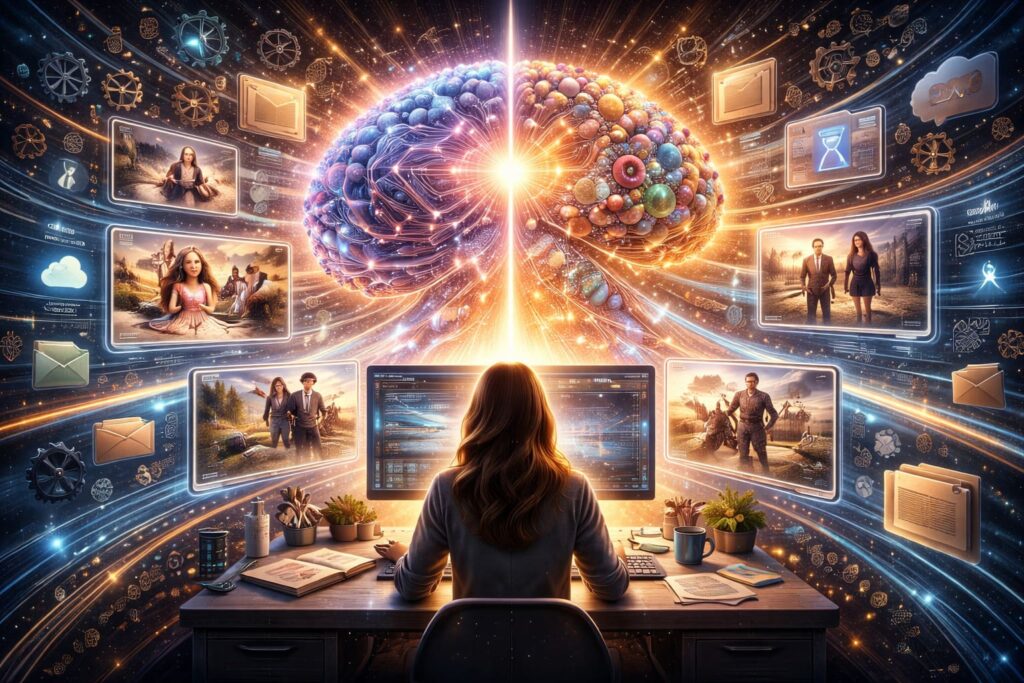
Hello! Today’s topic is very fascinating. It turns out that most people still think of memory as something like a camera. It’s as if we experience something, our brain “records” it, stores it somewhere, and then, whenever we want, we simply recall the same information later. At first glance, this sounds logical, especially considering that this is probably how most of us have imagined memory for years. But in reality, memory works much more complex.
Modern neuroscientists argue that memory is not a perfect record of the past, but a process of reconstruction. Every time you recall something, your brain reassembles the memory from fragments of information, emotions, sensations, and meanings. Moreover, your current mood, beliefs, and self-understanding can also influence how these fragments come together.
In other words, remembering something isn’t necessarily simply looking back into the past. To some extent, you’re also viewing it through the lens of who you’ve become since then.
Memory Is Not a File, But a Recovery Process
In fact, it turns out that your brain doesn’t store perfect images or videos. It stores fragments: sensations, emotions, and meanings. When you recall an event, your brain integrates these fragments with your current beliefs and emotional state. This is why a memory from ten years ago may feel completely different today, even if you’re convinced you’ve always remembered it the same way.
Several factors can influence this process:
- Emotional filtering: Strong emotions can make certain fragments of an experience extremely vivid, while other details gradually become less accessible to recall.
- Narrative smoothing: As we mature and develop a clearer sense of self, our memories can become more consistent with the personal story we’ve constructed around ourselves.
- Meaning adjustment: When our beliefs or understanding of a situation change, we may reinterpret what happened and remember individual details differently.
- Reconstruction: Every time we recall an event, our brain is forced to recreate it, meaning there’s always the possibility that details will be changed, added, or linked together in new ways.
This doesn’t necessarily mean our brain is constantly making things up. Rather, it’s a matter of how the memory system is designed: it must reconstruct something from incomplete information, rather than simply reproducing an unaltered record.
False Memories: When You Recall Something That Never Happened
In my opinion, this is perhaps one of the strangest aspects of memory. Sometimes people can recall events that never actually happened, and what’s even more interesting is that these memories don’t always seem made up. A person may be completely convinced that they remember a specific conversation, a childhood episode, an argument, a relationship, or an emotional moment—even if some or all of the details are incorrect.
The problem is that certainty and accuracy aren’t always the same thing. You can be absolutely certain that something happened exactly that way, and yet recall it incorrectly. Your brain isn’t necessarily trying to deceive you; it’s simply trying to create a version of the past that makes sense based on the information available to it. Once you understand this, memories will seem much less like photographs and much more like stories that are reconstructed every time we revisit them.
Why Childhood Memories Can Change So Much
Childhood memories are particularly interesting because children do not always perceive events the same way adults do. A child may remember a situation primarily through an emotion—fear, a sense of rejection, embarrassment, love, or confusion—without fully understanding what exactly caused that feeling. Years later, an adult, looking back on the same memory, may unconsciously find a much more logical explanation for it.
Perhaps you remember that someone didn’t want to talk to you, and for many years you interpreted this as rejection. Then, much later, you discover that something else was going on at the time—something you simply couldn’t understand as a child. The initial feeling may remain entirely real, but the explanation you gave it may turn out to be incorrect.
This is one of the reasons why childhood memories can seem so strange when we revisit them as adults. We don’t always recall those experiences from the same perspective as before. We recall them as the people we are now. In fact, these are significant insights.
Every Memory Is a Renewal Of Your Identity
And that brings me to the point that I find most interesting. If our memories help shape our personality, our beliefs, our relationships, and how we understand ourselves, then changes in memory can also influence how we perceive our own identity.
Think about it. Something happened to you many years ago, and at the time, you interpreted it in your own way. Then you grew up, went through a lot, changed your views, met different people, and came to a completely different understanding of yourself. When you eventually revisited that old memory, it probably no longer evoked the same feelings in you. The past itself, of course, hasn’t changed, but your attitude toward it has.
Perhaps this is why some memories suddenly become important when we reach a certain stage in life, while other things we once considered significant lose their emotional significance over time. The memory still exists, but the meaning we attach to it has changed because we ourselves have changed.
So perhaps memory isn’t actually a set of perfectly preserved files stored somewhere in the brain. It’s more of a continuous process that constantly connects the past to the person we are in the present. Every time we recall something, we recreate a small fragment of our own story. And through this, we recreate ourselves—albeit to a very small extent.
What do you think about this? Have you ever remembered something for years, only to find out later that it actually happened quite differently from how you remembered it? I’d love to hear your stories.