
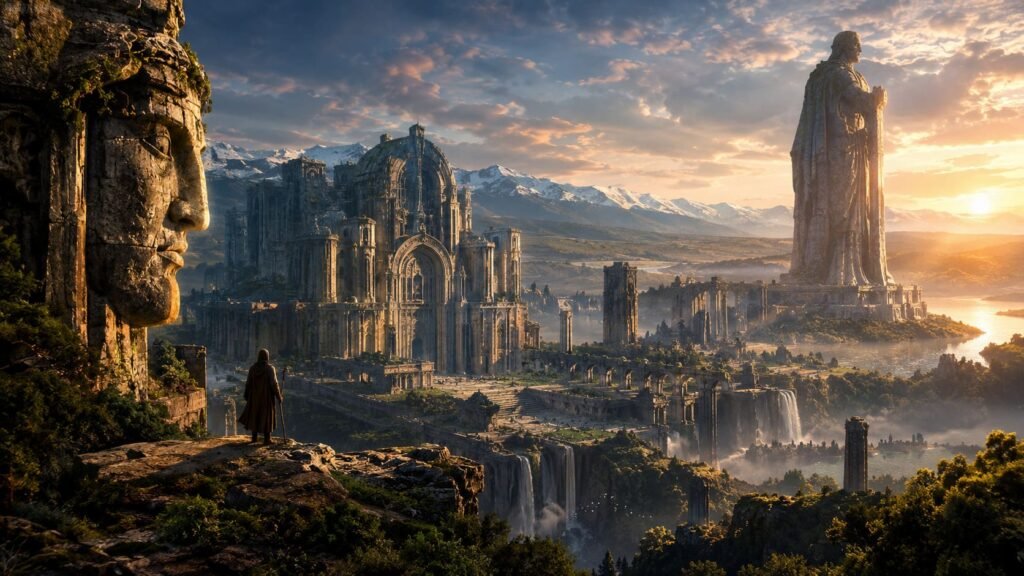
The idea of an ancient giant civilization sounds like mythology at first, but the deeper you look into megalithic architecture, oversized artefacts, unusual historical maps and the climate of the distant past, the question becomes more interesting than the simple story of “giants once walked the Earth.” There are genuine objects that appear strangely oversized, landscapes whose ancient climate was radically different from the one we know today, and archaeological structures whose construction still raises questions about the technology, organization and physical capabilities of the people who built them. None of this proves that a lost race of enormous humans existed. That is an important distinction.
The interesting possibility is whether several apparently unrelated anomalies could belong to a much older chapter of human history that has been misunderstood, compressed or partially lost. If a civilization existed before a major environmental catastrophe, and if the physical conditions on Earth were substantially different from those of the present day, then even some familiar archaeological mysteries might look very different when viewed through that lens.
This article is therefore not an attempt to replace one official story with another. It is an examination of a possibility: what if the world inhabited by some ancient builders was physically and climatically different from our own, and what if the people who lived in that world were considerably larger than modern humans?
Ancient Giant Civilization: Why Does the Idea Keep Returning?
Stories of giants appear in remarkably different cultures. Ancient traditions speak about unusually large beings, primordial races, Titans, Nephilim, enormous ancestors and people who supposedly lived during an earlier age of the world.
Mythology by itself cannot establish historical fact. Stories change as they are transmitted, and ancient writers frequently used exaggerated physical size to represent power, violence, divine ancestry or the remoteness of an earlier age. The more interesting question is why the image of a giant appears so often alongside traditions about a lost world.
Across many cultures, there is a recurring narrative structure: an earlier age was different from the present, enormous beings or extraordinary ancestors lived during it, and some great event brought that age to an end. The details vary enormously, but the general pattern is difficult to ignore.
That does not mean that every legend preserves a literal historical memory. It does, however, make the legends worth comparing with physical evidence rather than dismissing them before the comparison even begins.
If there really was a civilization substantially older than the civilizations normally associated with monumental architecture, we would expect some traces of it to survive indirectly: unusually large structures, oversized objects, abandoned settlements, altered landscapes, fragments of technology and perhaps biological remains that do not fit comfortably into the conventional picture. Some of those things do exist. The question is what they actually tell us.
The Megalithic Problem: Who Built Structures on This Scale?
Few things create a stronger impression of a vanished civilization than a megalithic monument. Stonehenge is an obvious example, but it is far from the only one. Across Europe, North Africa and the Near East there are structures made from stones whose transportation and placement required extraordinary planning and collective labour.
At Stonehenge, the larger sarsens weigh around 20 tonnes on average, with the largest approaching twice that weight. The British Museum notes that moving them from the Marlborough Downs, roughly 40 kilometres away, would have required enormous logistical effort and probably generations of organized labour. The smaller bluestones were transported from the Preseli Hills in Wales, around 350 kilometres away.
The Menga dolmen in southern Spain is even more striking in terms of individual stone weight. A geological study published in Scientific Reports found that some of its stones weigh nearly 150 tonnes, making it one of the most colossal megalithic monuments constructed in prehistoric Europe.
This raises an obvious question:
Why assume that people capable of organizing such projects must have been physically ordinary simply because we are physically ordinary?
There is no need to invoke giants to explain megalithic construction. Humans can move surprisingly large objects when they have enough people, time, leverage, sledges, ramps and organizational discipline. Experimental archaeology has demonstrated many techniques that allow relatively small groups to move objects that initially appear impossible. In other words, the existence of massive stones is not evidence that giant humans built them.
But it does tell us something important: ancient societies possessed organizational and engineering abilities that are easy to underestimate when we look at the finished monument without reconstructing the process that produced it.
The Great Pyramid provides another example. Its average blocks are estimated at roughly 2.5 tonnes, while some granite elements weigh tens of tonnes. Recent engineering studies continue to debate precisely how the largest elements were transported and raised, even though there is no serious need to assume that the builders themselves were giants. The mystery therefore shifts.
Instead of asking only, “Could ordinary humans have built this?”, we can ask a more useful question:
What was the actual technological and social environment in which these structures were created?
That question leaves considerably more room for discoveries.
Ancient Giant Civilization and the Strange Scale of Architecture
Megaliths are not the only structures that can create an impression of disproportion. Some ancient and medieval buildings contain enormous entrances, monumental staircases, unusually tall halls and doors that seem excessive when compared with the average human body.
It is tempting to look at such architecture and conclude that the buildings were designed for people much larger than ourselves. But architecture has never been purely practical. A door can be enormous because a king was supposed to pass through it. A temple entrance can be deliberately oversized to create a sense of approaching the divine. A cathedral can use monumental proportions because the entire purpose of the building is to overwhelm the visitor.
Ancient Egypt provides many examples of deliberately colossal architecture. The Metropolitan Museum, for instance, describes gigantic temple doorjambs associated with the monumental architecture of Ramesses II. Their scale was part of the visual language of royal and religious power. This is a crucial counterargument to the giant-civilization hypothesis.
A large doorway is not automatically a doorway for a large person.
Yet there is still something worth investigating when oversized architectural features appear repeatedly alongside other anomalies. Rather than treating every large door as evidence of giants, it makes more sense to document the dimensions, determine the building’s date and function, compare it with contemporary architecture and ask whether its proportions have an obvious symbolic or practical explanation. The important point is not to collect photographs of large doors. It is to look for patterns.
If genuinely human-scale structures repeatedly contain functional features that are inexplicably oversized, and if those features cannot be explained by ritual, symbolism, construction methods or the movement of large objects, then the question becomes considerably more interesting.
The Vatican’s Enormous Manuscripts
The Vatican Library is another place that frequently appears in discussions about supposedly oversized artefacts. There really are exceptionally large manuscripts in the collection. The Vatican Library itself describes the Urb.ebr.1, the so-called Volterra Bible, as its largest manuscript by thickness and weight. Created in Germany in 1294, it measures approximately 580 × 420 millimetres, is about 330 millimetres thick and weighs 45.7 kilograms. The digitization process was complicated enough that two people were required to handle the manuscript. That is an extraordinary object. But it is not a book designed for giants.
Its dimensions are perfectly compatible with a manuscript produced for monumental presentation and prestige, rather than everyday reading. The Vatican Library contains around 180,000 manuscripts and archival documents and millions of printed books, reflecting centuries of collecting and preservation. So the existence of an enormous manuscript is not evidence of an earlier race of giant humans.
What it does demonstrate is how easily an impressive object can become detached from its historical context and acquire a completely different meaning in modern retellings. That is exactly why an investigation into alternative history needs to be more demanding than a collection of photographs labelled “proof.” An anomaly becomes useful only after we establish what the object actually is.
Giant Swords Are Real — But What Were They For?
Oversized swords provide a more complicated example. Some historical swords really were enormous by modern standards. The Metropolitan Museum holds a German two-handed sword from around 1560 measuring 180.3 centimetres in total length and another South German example measuring 182.8 centimetres. The Walters Art Museum has a German two-handed sword measuring 192.7 centimetres.
There are also Bronze Age “giant swords” that are even more intriguing because their dimensions made them impractical as ordinary weapons. Archaeological research on the Ommerschans hoard describes a Bronze Age sword almost 70 centimetres long that was too large to be comfortably used as a normal weapon and may have had a ceremonial or symbolic role. This is where the giant hypothesis encounters another problem. A sword taller than many modern people does not necessarily mean that its owner was equally tall.
Two-handed swords were designed for particular fighting techniques, and some later examples became ceremonial objects. Museums explicitly identify examples that could reach six feet and explain their eventual ceremonial use.
At the same time, oversized weapons are fascinating because they raise a different question: why did societies repeatedly create objects whose dimensions exceeded what an average person needed for ordinary use? Ceremony is one answer. Status is another. Symbolism is another. And perhaps, in some cases, the proportions of the original user played a role.
The evidence is not strong enough to conclude that giant swords belonged to a lost race of enormous humans. It is strong enough to show that the historical world contained objects whose scale is sometimes surprising and whose original function is not always obvious at first glance.
Could the Earth Once Have Supported Much Larger Humans?
This is where the hypothesis becomes more speculative. The proposed ancient world is not simply imagined as a place where humans were genetically different. It is often described as having a different atmosphere, higher oxygen concentration, greater atmospheric pressure and a warmer climate. There is a real scientific basis for one part of this idea.
Earth’s atmospheric composition has changed dramatically over geological time. During the Permo-Carboniferous, atmospheric oxygen may have reached levels approaching 35%, substantially above today’s roughly 21%. Researchers have long investigated the connection between these conditions and the spectacular size of some Paleozoic insects and arthropods. Giant insects are therefore not a myth. Carboniferous arthropods reached sizes that would look almost impossible today. However, there is an important limitation.
The evidence linking high oxygen to gigantism is strongest for insects and other arthropods, whose respiratory systems differ fundamentally from those of humans and other vertebrates. A 2010 review found evidence supporting an oxygen-size relationship in insects, while a 2026 Nature study challenged the idea that oxygen diffusion through insect tracheoles was the main factor limiting insect gigantism.
There is currently no comparable body of evidence showing that an oxygen-rich atmosphere would have allowed humans to grow to several metres tall. That does not make the atmospheric hypothesis impossible in a purely speculative alternate-history model. It means that we should not present it as established biology.
If a lost giant civilization really existed, the explanation would probably require much more than oxygen alone. Genetics, nutrition, development, skeletal biomechanics, gravity, disease, reproduction and the availability of food would all have to be considered. The atmospheric idea is therefore best treated as a starting hypothesis rather than a conclusion.
A World Without Winter?
The climate portion of the theory becomes considerably more interesting because Earth’s deep past really did contain environments that would look alien to us. Modern Siberia is associated with extreme cold, permafrost and long winters. Yet this is not the only climate Siberia has ever experienced.
During the early Eocene, roughly 56–47.8 million years ago, parts of Arctic Siberia supported vegetation that would look astonishing in the modern Arctic. Research on the New Siberian Islands found evidence for palms, mangroves and other warm-climate vegetation at more than 72° north latitude. The study reconstructed mean annual temperatures of approximately 16–21°C, with winter temperatures of roughly 5.5–14°C in the studied interval.
The US Geological Survey likewise describes evidence of warm Arctic environments containing palms and other subtropical plants during the Paleocene-Eocene Thermal Maximum. That is genuinely remarkable. It means that the statement “there could never have been palms in the far north” is simply wrong if we are talking about Earth’s entire geological history. But there is a catch that matters enormously for the giant-civilization hypothesis.
These warm Siberian environments existed tens of millions of years ago, long before anatomically modern humans and therefore long before any plausible human civilization. The evidence proves that Earth’s climate can be radically different from today’s climate. It does not prove that medieval or prehistoric humans lived in a tropical Siberia. That distinction should remain visible. Still, it opens an interesting door.
If the climate of Earth has shifted so dramatically in the past, could the environment of the human past also have been substantially different from what we imagine? The answer is unquestionably yes. The harder question is how recently and how dramatically.
What Do the Mammoths Tell Us?
This is where the story becomes particularly fascinating. Mammoths preserved in Siberian permafrost can retain astonishingly detailed evidence of their final environment. Their stomach and intestinal contents, pollen, seeds, plant fragments and even DNA can be analysed thousands of years after death.
One study of a mammoth from northern Yakutia found grasses and sedges as the dominant food, together with willow twigs and a variety of herbs and mosses. The researchers reconstructed an extensive cold, treeless grassland environment rather than a tropical landscape.
Another study of the famous Yamal mammoth calf Lyuba used microscopic plant remains and ancient DNA to reconstruct its environment. The results were consistent with a mammoth-steppe ecosystem dominated by grasses and sedges, with additional herbs, mosses and dwarf willow. There is, however, a detail that makes the popular version of this story much more interesting. Some mammoth intestinal samples contain plants from the buttercup family.
In the Yamal mammoth material, researchers identified seeds of Ranunculus species, including Ranunculus cf. flammula. Another analysis of Siberian mammoth digestive material identified Ranunculus and other herbaceous plants. That is real evidence.
What is less secure is the popular claim that a mammoth was found with an entire mouthful or stomach full of freshly blooming flowers, proving that it was suddenly frozen in a warm paradise. The scientific record is more complicated. The plant remains tell us about the environment in which the animal fed, but they do not by themselves establish an instantaneous transition from tropical warmth to catastrophic freezing.
Some exceptionally preserved mammoths may have died through drowning, accidents or other causes, while their remains were subsequently buried and preserved in permafrost. The circumstances varied from specimen to specimen. This is an important distinction because preservation is not the same thing as instantaneous freezing.
Nevertheless, mammoths do provide one of the strongest windows into past Siberian ecosystems, and what they reveal is more complicated than the simple image of a frozen wasteland.
The Mammoth Steppe Was Strange Enough Without Being Tropical
The Pleistocene environment of northern Eurasia was not simply an endless ice sheet. Researchers describe the mammoth steppe as a highly productive cold grassland with grasses, sedges, herbs and shrubs. NASA’s reconstruction of East Siberian Arctic environments notes that vegetation included grasses, sedges and wormwood as well as plants from the rose, buttercup and daisy families. This matters because it changes the way we imagine the Ice Age.
The phrase “Ice Age” encourages a picture of everything being buried beneath kilometres of ice. Much of northern Eurasia was instead a cold, dry, open ecosystem capable of supporting enormous herds of herbivores. The existence of mammoths in such an environment therefore does not contradict the Ice Age.
What remains genuinely interesting is the speed and nature of some environmental changes recorded around the end of the Pleistocene, when many large animals disappeared and ecosystems were reorganized. That is a much stronger scientific question than the claim that every mammoth must have been frozen instantaneously by one global event.
Did Antarctica Once Have No Ice?
Ancient maps are among the most visually compelling pieces of evidence used by alternative historians. The Piri Reis map of 1513 is probably the most famous example. Its southern landmass has been interpreted by some writers as an accurate depiction of Antarctica before the formation of its ice sheet. If that interpretation were correct, it would be extraordinary. The problem is that historical cartography offers another explanation.
Cartographers before the modern age frequently depicted a hypothetical southern continent known as Terra Australis, based partly on ancient geographical ideas. The Library of Congress explains that Oronce Fine’s 1531 map, for example, depicts a vast hypothetical southern continent because geographers believed such a landmass should exist to balance the northern continents.
The same problem applies to the Piri Reis map. Cartographic historian Gregory McIntosh argues that the southern landmass has been misinterpreted as Antarctica and instead belongs within the tradition of early modern maps of the hypothetical southern continent. That does not make the maps uninteresting. Quite the opposite.
They show us how uncertain geographical knowledge once was and how easily later generations can project modern geography backwards onto historical documents. There is also a legitimate geological fact underneath the controversy: Antarctica has not always been the frozen continent we know today.
Earth’s climate has repeatedly produced periods when Antarctica was dramatically warmer, and geological evidence shows that large parts of the continent supported forests in deep time. The problem is chronology.
The existence of an ice-free Antarctica millions of years ago does not automatically place an ice-free Antarctica inside human history. For the giant-civilization hypothesis to work, we would need evidence of a much more recent ice-free Antarctic environment — not merely ancient geological warmth. That evidence has not been established.
What If the Maps Preserve a Memory Rather Than a Measurement?
There is, however, another possibility worth considering. Perhaps some ancient maps should not be interpreted as literal surveys of a vanished world. Perhaps they preserve fragments of older geographical traditions.
A mapmaker could copy an earlier source without understanding exactly where its information originated. A coastline might be distorted, combined with another coastline or incorporated into a theoretical landmass. A location that looks surprisingly accurate today might be the result of several generations of copying rather than direct observation.
That still leaves a fascinating question:
How old were some of the geographical traditions that later cartographers inherited?
The answer may be impossible to determine in some cases.
This is one of the areas where alternative history becomes genuinely interesting. The disappearance of a source does not prove that the information contained in it was true, but it does create uncertainty about the history of knowledge. An old map can therefore be evidence of an old map. It is not automatically evidence of an ancient global civilization. That distinction keeps the mystery alive without turning speculation into fact.
Could a Catastrophe Have Buried an Earlier World?
The idea of a catastrophe destroying or burying an earlier civilization fits naturally into the giant-civilization hypothesis. Across the world, buildings contain lower levels that are now below modern ground level. Cities have been buried, abandoned, rebuilt and repeatedly modified. Floods, earthquakes, volcanic eruptions, landslides, sediment accumulation and urban rebuilding can all produce archaeological layers that look surprisingly deep.
Some examples are genuinely dramatic. But the existence of buried buildings does not automatically imply one worldwide catastrophe. Different cities have different histories.
Some were buried by floods. Others accumulated sediment gradually. Some were deliberately raised and rebuilt. Others were destroyed and reconstructed repeatedly over centuries. That does not mean a global catastrophe is impossible. It means the evidence has to be assembled geographically and chronologically rather than treating every buried structure as part of one event. This is exactly why the buried-city question deserves to be examined separately.
Cobaltok has already explored this possibility in “Buried Cities and Erased Timelines: Why Our History May Be Younger Than We Think,” where the focus is on the recurring appearance of buried urban layers and the possibility that our conventional chronology may not explain every anomaly equally well.
The two hypotheses can therefore be connected without pretending that the connection has already been demonstrated. If a major catastrophe occurred, what happened to the people who survived? What happened to their technology? How quickly did climate and geography change? Could an older population have disappeared while later societies reused its buildings? Those are much more interesting questions than simply asking whether a particular photograph “proves giants.”
The Biggest Problem With the Giant Hypothesis
There is one piece of evidence that should be conspicuously absent from any serious article claiming that giants once ruled the Earth:
a verified giant human skeleton.
If humans several metres tall once formed a widespread civilization, we would expect archaeology to have found their remains in significant numbers.
There are many photographs online showing supposed giant skeletons, but most famous examples are hoaxes, altered images, misunderstood fossils or stories that cannot be traced to reliable archaeological documentation.
This is where the hypothesis encounters its strongest obstacle. Architecture can survive without its builders. A sword can survive without its owner. A manuscript can survive without its reader. A map can survive without the civilization that inspired it. Human bones are much harder to explain away.
If a lost giant population existed on a large scale, skeletal evidence should eventually become one of the strongest parts of the case. So far, it is not. That does not make every anomalous structure meaningless. It simply means that the claim of a widespread race of giant humans currently has a major evidentiary gap.
A More Interesting Version of the Giant-Civilization Hypothesis
Perhaps the hypothesis does not need to be as extreme as it is usually presented. Instead of imagining a planet populated by ten-metre humans, consider a civilization whose people were larger on average than modern populations, lived under somewhat different environmental conditions and inherited architectural traditions from an even older society.
That would produce a very different archaeological signature. Doors might be somewhat larger. Furniture and tools might be oversized. Weapons could be longer and heavier. Buildings might have proportions that seem excessive to us. Individual unusually tall people could become legendary ancestors.
Over generations, their physical characteristics could disappear while the structures associated with them remained. This scenario is still speculative, but it does not require breaking as many biological and archaeological rules. It also provides testable predictions.
If such a population existed, we should find skeletal remains with statistically unusual height distributions. We should find artefacts whose dimensions correlate with those individuals. We should see regional patterns rather than isolated curiosities.
Most importantly, those findings should occur in securely dated archaeological contexts. That is the kind of evidence that could turn an interesting alternative-history idea into a genuine archaeological question.
What Would We Need to Find?
A convincing case for an ancient giant civilization would require much more than photographs of enormous buildings. Several types of evidence would be particularly important.
Human remains: securely excavated skeletons demonstrating a population significantly taller than known human groups from the same period.
Contextual artefacts: tools, weapons, furniture or clothing demonstrably associated with those remains and appropriately scaled to them.
Dating: reliable independent dating placing the population in the proposed period before the supposed catastrophe.
Genetic evidence: DNA showing whether these people belonged to known human populations or represented a previously unknown lineage.
Settlement evidence: houses, roads, graves and everyday infrastructure corresponding to the proposed population.
Environmental evidence: pollen, sediments, ice cores and other proxies showing that the climate of the relevant period differed substantially from modern conditions.
Catastrophic horizon: geological and archaeological evidence for a major event occurring at approximately the same time across widely separated regions. That would be extraordinary evidence. It would also be much harder to dismiss than a collection of mysterious photographs.
The Possibility of a Forgotten World
There is a seductive simplicity to the conventional image of history: humans gradually developed agriculture, cities, monumental architecture and increasingly complex technology, leaving a relatively straightforward trail from the distant past to the present. Real archaeology is considerably messier.
Civilizations disappear. Languages become extinct. Cities are abandoned. Buildings are reused. Climate changes. Trade networks collapse. Entire technologies can be forgotten. A later population may occupy the ruins of an earlier one without understanding who built them. The archaeological record is therefore not a complete autobiography of humanity. It is a collection of surviving fragments.
That does not mean that every gap hides a lost civilization, but it does mean that we should be careful about assuming that the surviving record is identical to the original one. The possibility of an ancient giant civilization sits somewhere inside that uncertainty.
The strongest evidence for it is not the photograph of a giant door or the image of a sword taller than a person. Those are intriguing, but each has conventional explanations. The more interesting case emerges when several independent categories of evidence begin pointing in the same direction: unusual human remains, anomalous architecture, unexplained artefacts, environmental changes, settlement layers and a demonstrable catastrophe. We are not there yet. But the questions remain.
Perhaps the people who erected these monumental structures were simply exceptionally organized individuals who employed methods we tend to underestimate. It is possible that some tales of giants are distorted memories of exceptionally tall people—warriors or members of ruling dynasties. Alternatively, these legends may preserve fragments of far older cultural traditions. Or perhaps there exists a chapter of human history that has yet to be reconstructed.
The important thing is not to decide which explanation we prefer before examining the evidence. If the history of the world really contains an older civilization hidden beneath layers of later construction, sediment and myth, the evidence should eventually become visible in places where speculation cannot easily manufacture it: in bones, dates, sediments, genetics and archaeological contexts.
Until then, the giant civilization remains what it should be — a provocative hypothesis rather than an established fact. And perhaps that is precisely why it is worth investigating.
Sources and Further Reading
- British Museum research and reconstruction of Stonehenge’s construction and the transportation of its megaliths.
- Scientific Reports study of the enormous stones used to construct the Menga dolmen.
- Research on the engineering problems surrounding the Great Pyramid.
- Vatican Apostolic Library records on the large Urb.ebr.1 manuscript and its collections.
- Metropolitan Museum and Walters Art Museum records for historical two-handed swords.
- Research on atmospheric oxygen and prehistoric gigantism.
- Research documenting palms, mangroves and subtropical vegetation in Eocene Arctic Siberia.
- Studies reconstructing mammoth diets and environments from intestinal contents and other remains.
- Library of Congress records concerning Oronce Fine’s 1531 map and the historical concept of Terra Australis.
- Gregory C. McIntosh, The Piri Reis Map of 1513, University of Georgia Press.
This article is an exploration of an alternative-history hypothesis. The existence of megalithic structures, unusual artefacts, ancient climate changes and buried archaeological layers is factual, while the proposed connection between these phenomena and a prehistoric civilization of giants remains speculative and is not established by current archaeological evidence.