
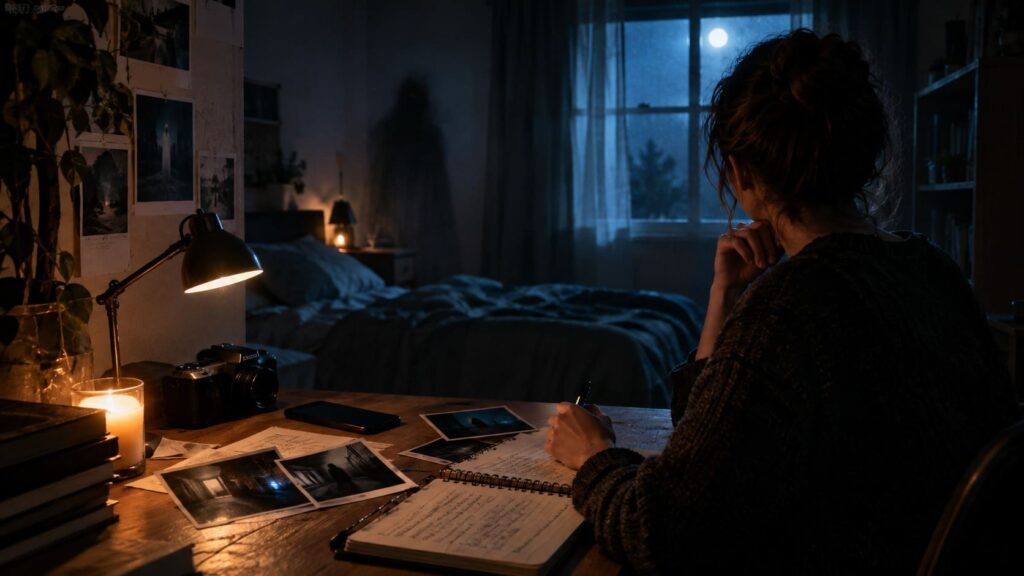
Paranormal experiences are often remembered precisely because they do not fit neatly into an ordinary explanation. You wake during the night and have the unmistakable feeling that someone is standing beside your bed. You think about a person you have not seen for years, only to receive a message from them a few hours later. A place you know well suddenly feels unfamiliar, or an entirely new situation produces the strange certainty that you have already lived through it.
It’s easy to dismiss such experiences, and just as easy to overinterpret them. But the difficulty lies in the fact that both of these reactions can distance us even further from what actually happened. Claiming that it was undoubtedly a paranormal phenomenon may give an inexplicable event an answer it does not deserve, while assuming that every unusual experience must have an obvious conventional explanation may prove just as hasty. A more interesting approach is to start with the experience itself and build from there.
What happened? What evidence was available at the time? Are there any alternative explanations that can be tested? Is there anything left unexplained after considering all these possibilities?
That may sound less dramatic than declaring that a ghost appeared or that the universe sent a message, but it gives us something much more valuable: a way to investigate the strange without having to choose between blind belief and automatic disbelief.
What Do We Actually Mean by a Paranormal Experience?
“Paranormal” is more of a broad cultural term than a scientific diagnosis. It is usually applied to experiences or events that are difficult to explain within the framework of modern scientific models, and this category encompasses phenomena as diverse as ghosts, unusual coincidences, prophetic dreams, telepathy, near-death experiences, déjà vu, and strange sensations during sleep. This diversity in itself poses a problem.
A person who hears footsteps in an empty house describes something entirely different from someone who believes they dreamed of an event before it occurred. If both of these experiences are simply lumped into the “paranormal” category, important distinctions will be lost before any investigation even begins. Therefore, it is advisable to describe the event without rushing to draw conclusions about its causes.
Instead of writing:
“A spirit entered my room.”
a more useful record would be:
“At approximately 3:15 a.m., I heard three sounds resembling footsteps in the hallway. I was awake, alone and did not see anyone.”
The first statement contains an interpretation. The second gives us something that another person could, at least in principle, investigate. That distinction becomes particularly important when an experience is vivid enough to feel self-evidently real.
An Experience Can Be Real Without Its Explanation Being Certain
People sometimes hear that an unusual experience was “just in their head” and understandably feel that this dismisses what happened to them. It does not have to. There is a difference between questioning the cause of an experience and questioning whether the person genuinely experienced it.
A person can sincerely hear a voice, see a figure or feel another presence nearby without deliberately inventing anything. Perception is not a perfect recording of the outside world; the brain is continuously interpreting sensory information, memories and expectations, and unusual conditions can produce experiences that feel remarkably external.
Sleep paralysis offers one of the clearest examples. During REM sleep, normal muscle activity is temporarily inhibited. Occasionally, elements associated with REM sleep overlap with waking consciousness, leaving a person aware of their surroundings while unable to move normally. For some people, this state also involves vivid visual or auditory experiences, including the sensation that another person or presence is nearby.
A 2024 systematic review and meta-analysis combined 76 studies from 25 countries, representing more than 167,000 participants. The pooled estimate of sleep paralysis was around 30%, although the studies varied considerably and the authors identified evidence of publication bias. Among recorded cases, visual and auditory hallucinations were reported in a substantial minority of episodes.
An earlier systematic review produced a very different figure for the general population: 7.6% had experienced sleep paralysis at least once, compared with 28.3% of students and 31.9% of psychiatric patients in the samples examined.
The difference between those numbers is not a contradiction that needs to be hidden. It is actually a useful lesson in how research works. Estimates can change substantially depending on the population, questionnaire, definition and study design being used.
For someone who wakes unable to move and sees a dark figure at the edge of the bed, the experience may be terrifying and completely convincing. Research can offer a plausible mechanism for that experience without requiring us to pretend that the person’s memory of it is somehow false.
Why Coincidences Can Feel So Significant
Sleep-related experiences are only one part of the story. Some of the most persistent paranormal questions come from coincidences.
Imagine thinking about an old friend you have not spoken to for ten years, only to receive a message from them that evening. There was no obvious reason for the timing, and the coincidence feels almost too precise to be random. It is tempting to stop there and ask what message the event was carrying.
A more useful investigation begins one step earlier: how often do events like this happen, and how often do similar thoughts produce no remarkable coincidence at all?
Human perception is extremely good at detecting patterns, which is one of the reasons we are able to navigate a complicated environment so effectively. The same ability can also make random events look connected when we do not have the full picture.
Research into paranormal beliefs has repeatedly examined this issue. A systematic review published in PLOS ONE analysed 71 studies involving 20,993 participants and found that the literature was far from uniform. The most consistent associations involved intuitive thinking, certain confirmation biases, conditional reasoning and the perception of randomness, while several other areas produced inconsistent results. The authors also highlighted methodological weaknesses in parts of the literature, including limited preregistration and heavy reliance on student samples.
That does not mean that every meaningful coincidence is an illusion. It means that pattern detection has to be considered before a coincidence is treated as evidence for something extraordinary. This is an important distinction because an alternative explanation does not automatically become the correct explanation simply because it sounds conventional.
Synchronicity Is Worth Investigating Rather Than Simply Believing or Dismissing
The idea of synchronicity occupies an interesting middle ground. In everyday language, people often use it for coincidences that feel personally meaningful even though there is no obvious causal connection between the events.
You think of someone, and that person calls. Or you’re racking your brain over a question and come across an unusually apt phrase in a book you happened to open. During times of major change in your life, you keep noticing the same unusual symbol.
None of these examples establishes a supernatural mechanism. At the same time, the psychological experience of meaningful coincidence is itself a legitimate subject of research.
Recent studies have started examining meaningful coincidences empirically, including their relationship with emotional states and creative activity. This is a more productive direction than trying to force every coincidence into either the “proof of something supernatural” or “completely meaningless” category.
The distinction matters because meaning and causation are not necessarily the same thing. An event can be deeply meaningful to someone without that meaning proving that an external force deliberately arranged it. That does not make the experience worthless. It simply keeps two different questions separate.
What About Intuition?
Intuition creates a similar problem. Most people have experienced the sudden feeling that something is wrong without being able to explain why. Sometimes that feeling turns out to be remarkably accurate, which can make it seem as though information arrived before conscious reasoning had a chance to process it.
There is nothing inherently mysterious about unconscious processing, however. The brain can register subtle changes in tone, facial expression, behaviour, timing and context without giving us a conscious account of every detail that influenced the final judgment. A person may therefore “know” that something is off without being able to explain how they know it.
That does not prove that intuition is paranormal, but it also does not make every intuitive experience trivial. The interesting question is whether the accuracy of a particular form of intuition can be demonstrated consistently under conditions where chance and hindsight can be ruled out. Without that kind of testing, an accurate intuition remains an interesting observation rather than proof of extrasensory perception.
The Problem With Remembering Only the Hits
This is probably the most useful principle for anyone who wants to investigate their own unusual experiences. Suppose you believe that your dreams sometimes predict future events. You have a vivid dream about a person you know, and two days later something happens involving that person. It is natural to remember the successful match.
The harder part is remembering every dream that did not correspond to anything. That is why prospective records are so valuable. Instead of writing down a dream after something happens and searching for connections, record it beforehand, including the details that would allow you to determine later whether the prediction actually came true. The same approach can be used for intuition, synchronicity and other recurring experiences.
If you think you can predict an event, write down the prediction before the event occurs. If you believe certain coincidences happen unusually often, keep a record of both the striking coincidences and the ordinary days when nothing unusual happened. The boring data may turn out to be more informative than the spectacular examples.
A Simple Method for Investigating Something Strange
You do not need a laboratory to begin collecting better evidence. A notebook, phone and a willingness to record inconvenient results are often enough.
1. Record the event as soon as possible
Write down the date, approximate time, location, people present, environmental conditions and exactly what you perceived. If technology was involved, preserve the original recording rather than relying on a screenshot or edited version. Your first account is particularly valuable because later conversations can influence how memories are reconstructed.
2. Separate observation from interpretation
This is one of the easiest changes to make and one of the most useful.
Instead of:
“Someone walked through the room.”
write:
“I saw a dark shape move from the doorway toward the window for approximately two seconds.”
The second description leaves room for several explanations. It also makes it possible for another person to evaluate the same evidence without first accepting your interpretation.
3. Record your state at the time
Sleep deprivation, waking from a dream, falling asleep, illness, stress, alcohol, medication and other factors can affect perception and memory. That information does not automatically explain an event, but leaving it out makes later analysis harder.
4. Test ordinary explanations first
Check the environment. Could the sound have come from plumbing, heating, an animal, a neighbour, wind or the building itself? Could a strange image have resulted from reflections, low light, peripheral vision or a camera artifact? The purpose is not to “debunk” your experience at any cost. You are simply giving competing explanations a fair chance.
5. Decide what would count as a hit before looking at the result
This is particularly important for predictions. If you dream that “something involving a friend will happen,” almost any later interaction could be interpreted as a match. A stronger prediction contains enough detail that you can later say, with reasonable confidence, whether it happened or did not.
6. Keep the misses
This is where many informal investigations fall apart. If ten predictions fail and one is spectacularly accurate, the spectacular event should not erase the ten failures. Keeping the complete record is what allows you to discover whether the unusual result is genuinely unusual.
The Three-Hypothesis Method
When something remains difficult to explain, try writing down three possibilities rather than choosing one immediately.
Ordinary explanation: a known physical, environmental, neurological or psychological mechanism accounts for the event.
Unknown explanation: something happened that cannot currently be explained because important information is missing or the relevant mechanism has not yet been identified.
Paranormal explanation: the event involved a mechanism that is not currently accounted for by conventional scientific models.
The point is not to give all three possibilities equal probability. They are simply competing hypotheses. Once they are written down, ask what evidence would distinguish them.
If a sound occurs every night at exactly the same time, for example, recording it repeatedly may reveal an environmental pattern. If an apparent prediction is documented beforehand and repeatedly performs better than chance, that would be considerably more interesting than a single anecdote remembered after the fact. Good investigation gradually turns vague mystery into a question that can actually be tested.
What Would Make an Extraordinary Claim More Convincing?
A compelling personal story is not worthless, but it is difficult to use as strong evidence because another person cannot independently examine the original conditions.
Evidence becomes considerably more useful when the observation is documented before the outcome, when alternative explanations are controlled, and when independent investigators can repeat the procedure.
For claims involving prediction or unusual information transfer, preregistration is particularly valuable because it prevents researchers from changing the rules after seeing the results. Replication matters for the same reason: an effect that appears only once is much harder to distinguish from chance, methodological problems or selective reporting than one that survives repeated testing by independent groups.
This is one of the reasons methodological criticism is so important in paranormal research. The systematic review of paranormal beliefs mentioned earlier found generally reasonable study quality overall, but also identified problems such as limited preregistration, multiple statistical tests and restricted participant samples. The lesson is not that paranormal research is pointless. If anything, it is the opposite: extraordinary questions deserve unusually careful methods.
Unexplained Does Not Automatically Mean Supernatural
There is a tendency to treat “unexplained” and “paranormal” as though they were interchangeable. They are not. If someone records an unexplained sound in an empty house, the honest conclusion may simply be that the available evidence does not establish its source. That statement is weaker than “a ghost caused it,” but it is also much more defensible.
The history of science contains many examples of phenomena that were poorly understood before researchers found better ways to describe and investigate them. That is a good reason to remain curious about anomalies, but it is not evidence that every mystery has a supernatural explanation waiting behind it.
There is another danger on the skeptical side as well. Once we know that sleep paralysis can produce a sensation of presence, for example, it would be tempting to use that explanation for every report of a presence during the night. The research does not justify that leap either. A plausible explanation for one class of experiences does not automatically explain every individual case.
Curiosity Works Better Than Certainty
Perhaps the most useful attitude toward paranormal experiences is neither belief nor disbelief, but disciplined curiosity.
You can take unusual experiences seriously without jumping to conclusions about their causes. You can be fascinated by synchronicities while also noting the coincidences that lead nowhere. Explore phenomena related to ghosts without assuming that every unexplained event is a spirit, and study unusual states of consciousness without reducing every strange experience to a single mechanism.
What matters is whether we are willing to follow the evidence even when it takes us somewhere less exciting than the original story.
Sometimes the result will be surprisingly ordinary. A strange sound turns out to have a mundane source, a vivid night-time encounter fits the known characteristics of sleep paralysis, or a series of coincidences becomes much less extraordinary once every missed prediction is included.
Sometimes, however, a case may remain genuinely unresolved. That is not a failure. An unresolved case is a reason to collect better evidence, not a reason to manufacture an answer.
For anyone interested in paranormal experiences, that distinction may be the most interesting place to begin. The mystery does not disappear simply because we investigate it carefully. In many cases, careful investigation tells us exactly where our current understanding ends — and that boundary can be far more interesting than a conclusion reached too quickly.
Research and Further Reading
- Prevalence and Clinical Characteristics of Sleeping Paralysis — systematic review and meta-analysis
- Lifetime Prevalence Rates of Sleep Paralysis — systematic review
- Paranormal Beliefs and Cognitive Function — systematic review
- Paranormal Beliefs and Individual Differences
A note on evidence
The research cited here does not prove or disprove paranormal phenomena as a whole. Most studies examine specific experiences, cognitive processes or beliefs that are sometimes interpreted as paranormal. Keeping those questions separate is essential: an explanation for one phenomenon cannot automatically be extended to every unusual experience.
This article is intended for informational and educational purposes only. It does not provide medical, psychological or professional advice.