
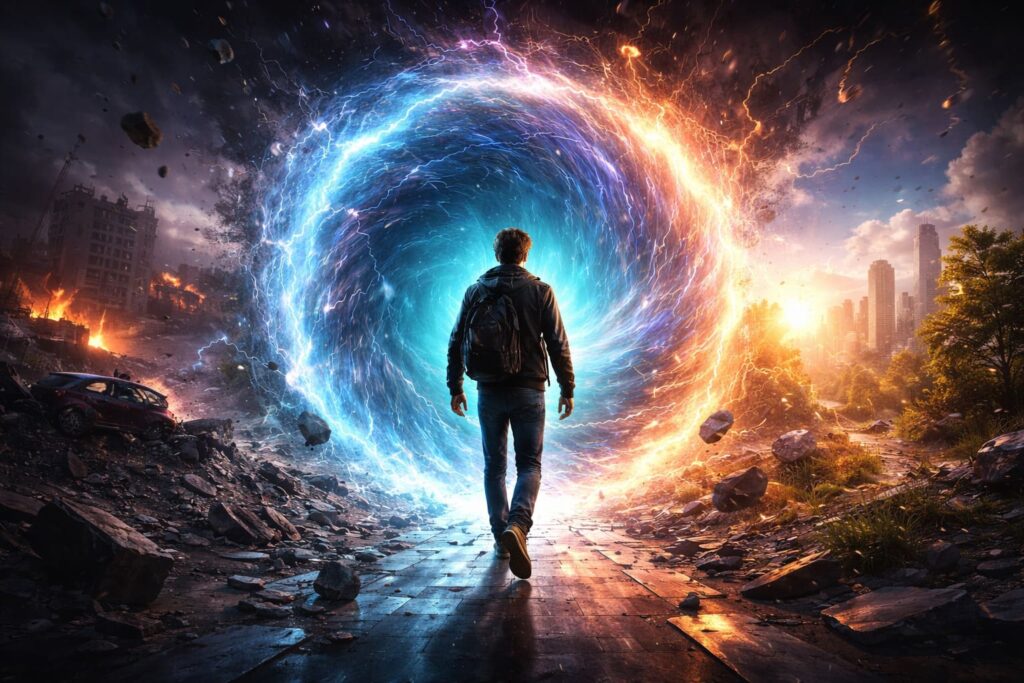
Hi! Where to begin… You know, I never expected quantum immortality to be more than just a late-night amusement—until it became my story. My exploration of quantum immortality began not in theory, but at a time when survival seemed statistically impossible, yet personally inevitable. One branch carried the inevitability of death. The next carried me—still breathing, still perceiving the world, still… imprinted in my consciousness.
Quantum Immortality: The Branch That Remembered Me
The concept of quantum immortality is deceptively simple: every time your life ends abruptly, consciousness doesn’t necessarily cease to exist. It lives on in the branch where you remained observable the longest. No dramatic rebirth scenes. No cosmic narrative voice. Just an unchanging truth: you only remember the version in which you didn’t die. Interesting, right?
That’s what initially alarmed me. Memory didn’t archive death. It archived a place where death couldn’t register my disappearance. My own near-death moment seemed pure and grounded in the laws of physics:
- the event unfolded faster than thoughts
- the consequences were predetermined to a greater extent than intuition could mitigate
- the body reacted like a machine that had no time to philosophize
- cause and effect merged into something that felt like an end
But it wasn’t an end. It was a twist in time. Afterwards, the surrounding world looked identical, but I felt out of place in it—as if someone had placed a save file into a duplicate of the game. It seemed to be the same scene, the same characters, the same rendering rules. But the result was different.
Reality Behaves Like an Indexing Engine
I compared this sensation to searching through space for a terrain reconstruction, from satellite elevation data to contemplating my state of consciousness. If the simulation had been visually glitchy, I might not have noticed. But it was glitchy in terms of my survival probability, not the graphics.
This got me thinking about something more important: what if the simulation uses consciousness to quality-control the narrative, and physics simply confirms the edited result later? Because chronology often behaves like an artifact cataloging system, preserving results rather than the original data.
The Past You Saw Isn’t the Past That Wrote You
Alternative historians sometimes cite buried cities, fires in archives and libraries, identical gaps in historical cartography, and duplicate events in the accepted official version of history. But the anomalies of survival are more quiet and personal. I began to understand how the mind shifts to a new level of consensus when life confronts contradictions in anticipation of death. Perhaps chronology has less to do with age and more to do with the stability of consciousness. What do you think?
Quantum Immortality as a Practical Lens
Another aspect of quantum immortality that later struck me: it’s not proven by words. It’s proven by living, as if your attention had chosen the path to survival before physics had even agreed. Luck is not your lifeline. Probability is your disguise.
Why Survival Matters More Than Proof
These anomalous cases of survival trigger a cognitive shift:
- We influence not the system, but the observer within it;
- We don’t rewrite the laws of physics, but rather the relationship with the outcome;
- We remember not the timeframes that destroyed us, but the timeframes that made us tangible.
Interestingly, the real anomaly wasn’t death, but the continuity that followed me along the branch where I didn’t disappear. This raises many questions that don’t yet have definitive answers. However, I believe the answer will emerge someday.
And consider this: if at the moment of death your consciousness jumps to the branch where you remained alive, and you don’t remember the fact of death, then how many times in your life have you likely already died?
Why Do People Debate Simulation Younger, but Fear Older?
At its core, this is a deeply philosophical question. You love philosophy, don’t you? You enjoy searching for meaning? Indeed, in youth, people often question reality itself: is our world real or just a simulation or a matrix? Conversely, in old age, people dislike such questions and carefully avoid them. But why?
I think it’s because a person who has lived a long life is already subconsciously afraid to ask such questions, because they want to believe that life is more than a matrix or a simulation. They want to believe that life was lived with purpose and had some meaning. What do you think?
FAQ
Q: Is Quantum Immortality deterministic or random?
A: Neither entirely. It depends on which branch awareness persists through outcome collapse the longest.
Q: Why don’t we remember death branches?
A: Because consciousness stores survival recognition, not erase confirmation receipts.
Q: Is luck the reason for survival?
A: Luck explains circumstances. Quantum Immortality selects the observable continuation.