
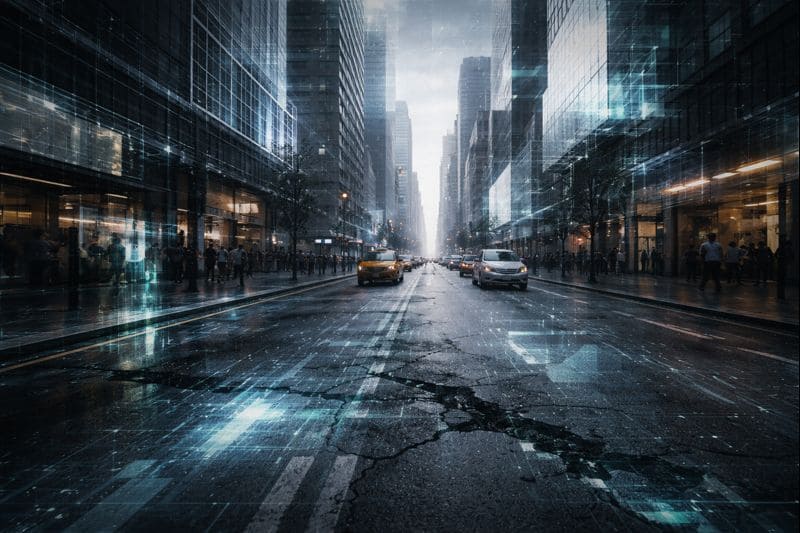
Greetings, reader! For years, my analysis of nested simulations was a barely audible whisper in my daily life—a subtle discomfort I couldn’t fully explain. Then I watched films about nested simulations and delved into the intertwined contradictions of history, identity, and urban life. That’s when I realized: The Matrix shatters its illusion not with graphics, but with awareness. It doesn’t fail, it reflects.
This realization aligns with the idea that perception functions as an active force, shaping how reality responds rather than merely reflecting a fixed structure. And you know what? I agree with that. I think that’s how it really is. What do you think?
Most people want proof that the system is a sham. I wanted to understand why it seemed so well-designed, so structured, and yet so secretive about its origins. Maybe we’re not victims of illusions. Maybe we’re units of refinement, constantly renewing our perceptions in a reality that wasn’t designed to appear well-designed. And if that sounds impossible, well… reality loves the impossible. Doesn’t it?
The Matrix as an Ordinary Illusion
You see, the paradox is that the Matrix works best when it feels normal. No dramatic neon grids flickering behind road signs. No raw landscapes or textures. Just ordinary horizons that seem constant because we don’t expect them to change. Once you accept this, history turns upside down. Reality isn’t a cage. It’s a perceptual processor, a system that produces consequences based on the intensity of attention. Do you understand?
Mud Flood Theory vs Mental Flood Theory
Alternative history is often accompanied by discussions about how the British Library preserves maps from different eras. They are called forgeries not because they are incorrect, but because their sources are ghosts. They simply don’t correspond to the official version of history. That’s all.
We can blame war or nature, but the trend of buried first and second floors of ancient cities is spreading across the world. From the historical layers of Edinburgh’s underground streets to the mythical layer of a lost era associated with concepts like the phantom time hypothesis.
Ground levels shift. Buildings remain.
Lower floors are filled in, and ancient archives and libraries are burned. History is rewritten to suit the ruling class.
But what if the real flood happened not in the mud, but in beliefs we never questioned? This is exactly what I’m tracking now: not buried ancient cities, but the hidden origins of how we describe time, identity, and reality, reflected in closed loops. What do you think about this?
Quantum Immortality Theory Review
Here’s the central idea that changed me: if consciousness survives in a nested system, then death isn’t always the end. Sometimes it’s just a file path. I should have died in one branch, but I woke up in another. Not because the system resurrected me. But because consciousness chose the branch where survival still existed as a fixed outcome.
The theory of quantum immortality isn’t a cinematic rebellion. It’s continuing to exist in the reality that has longest confirmed your presence. Without any ceremony or rosy exits. Simply: you opened your eyes there, so the system preserved that version.
I’ll tell you an interesting dream on this topic that I had not long ago. I had a best friend who died in the war. I dreamed that I was passing his house and saw him lying on the grass by the road, enjoying the summer sun. I approached, greeted him joyfully, and told him I thought he was dead. And do you know what he said to that? He said, “I thought you were dead.” It was as if we’d literally entered different worlds of reality, where we were considered dead to each other.
The Psychology of Pre-Installed Templates
Most beliefs feel original until you audit their source. That’s how nested simulations work:
- History feels linear after a collapse because copies always end up synchronized
- Ground levels shift faster than the records explain them
- Identity is treated like a save-file, not a headline
- Consciousness behaves like a traveler that doesn’t get a receipt
- Anomalies appear without provenance because provenance is never the point
The matrix doesn’t break the illusion unless the illusion is no longer educational.
Perception Is the Hidden Console
Now my rule is this: the deeper you see, the less the world scares you. Because fear isn’t a mistake. Fear is a protective layer of the interface for enhancing awareness. The Matrix wants only one thing from you: to notice boundaries, even if the system itself doesn’t visually acknowledge them. Awareness doesn’t destroy the simulation. It writes into it.
Nested Worlds in Daily Perception
Nested simulation requires no special effects. Its effectiveness lies in continuity, symbolism, and the silent recursion of experience. If perception is a tunable instrument, then anomalies are interference patterns, not errors. They are confirmations of superposition. Reality reflects itself because it waits until improvements in attention fully transform into recognition.
FAQ
Q: Can consciousness influence the matrix or only observe it?
A: Observation is the first level of influence. When you see seams, you change what they processed around you.
Q: Is Quantum Immortality safe to discuss without proof?
A: It’s not empirical science, but it’s a persistent observer-based theory worth exploring through perception loops, contradictions, and survival logic.
Q: Why world data feel inherited, erased, or unmentioned by design?
A: Possibly because the world stores recognition, not receipts.